
How to share tennis and pickleball courts without double bookings
If your club has added pickleball lines to its tennis courts, or is thinking about it, the paint is the easy part. The schedule is harder: who gets the court on Saturday at 9:00, what each sport pays, and how members find out. This guide covers the options, the layout basics, and the booking rules that keep the two sports from clashing.
By the Tennisbook team. Updated .
Four ways to share courts
There are four common approaches, and you can mix them:
| Approach | How it works | Works well when | Watch out for |
|---|---|---|---|
| Dedicated courts | Some courts are tennis only and some are pickleball only. | You have enough courts and steady demand for both sports. | It's hard to undo, and one sport's courts can sit empty while the other waits. |
| Blended lines | Pickleball lines are painted on a tennis court, and the court is used for one sport at a time. | You have a small site and want flexibility. | Tennis members see extra lines, and someone has to set up and take down pickleball nets. |
| Sport blocks | A shared court is pickleball at set times, such as weekday mornings, and tennis the rest of the week. | Members want a schedule they can learn once. | Blocks that don't match demand, and members who don't know the schedule. |
| Book by sport | Each court is set to tennis, pickleball, or both. Members choose the sport when they book a shared court. | Demand shifts week to week. | Your booking system has to treat a shared court as one court. Otherwise tennis and pickleball overlap. |
You can combine them, for example with a few single-sport courts, a row of shared courts, and sport blocks at your busiest times.
Lines and layout: start with the official guidance
Don't guess at measurements. Two sources cover most of what a club needs:
- USA Pickleball lists the court as 20 feet wide by 44 feet long. Its rulebook gives 30 by 60 feet as the minimum playing surface, and 34 by 64 feet for new construction. See USA Pickleball court construction and the official rulebook.
- The USTA Statement of Guidance on tennis and pickleball, written for public facilities, recommends blended lines for sites with two or fewer tennis courts. For sites with three or more, it asks for dedicated courts for each sport wherever possible. For blended lines it suggests up to two pickleball courts on a tennis court, one on each side of the net, painted in textured line paint a shade lighter than the surface, 1½ inches wide, and stopping 3 inches short of the tennis lines. See the USTA Statement of Guidance.
Note: Talk to your court builder or resurfacer before you paint. They know your surface, your fencing, and the space around each court.
Pickleball can be louder than tennis. Think about neighbors, nearby houses, and local rules before you choose which courts to share.
Booking rules that prevent clashes
- One booking holds the whole court. A shared court is one physical court. Once it's booked for pickleball, it shouldn't show as open for tennis, and the other way around.
- Ask for the sport at booking time. Then the desk and other members can see what's on each court, and you can price each sport.
- Price each sport on its own terms. You might use the same hourly price for both, or a different one for each.
- Use the same booking window for both sports. If one group can book further ahead, it can fill your best times before the other group gets a chance.
- Decide who gets prime time. Saturday at 9:00 and weekday evenings are where clashes happen. Use a higher prime-time price, sport blocks, or a few single-sport courts.
- Offer booking lengths both groups use, such as 60 and 90 minutes, and price each length.
- Hold the weekly group with a standing booking, and close courts for rain, resurfacing, or tournaments. Then the open times members see are real.
Write the rules down in a short court policy, and put it where members book.
Signs and member communication
- Use the same court names everywhere. Court 4 on the gate is Court 4 on the court sheet and the booking page. If you group courts, name the group the way members say it, such as Pickleball row.
- Post the sport schedule at the courts and next to your booking link.
- Agree on net etiquette: who sets up and takes down pickleball nets, where they're stored, and how many minutes before the end of a booking to start.
- Explain any price difference between the sports in one sentence.
- Tell members before anything changes, with one email that covers the new schedule, the rules, and where to book.
- Ask both groups after a month, and adjust blocks and prices from what you hear and what the court sheet shows.
How shared courts work in Tennisbook
In Tennisbook, each court is set to Tennis, Pickleball, or both. A court set to both is a shared court:
- Members choose the sport when they book a shared court, and a booking in either sport holds the whole court. Staff choose the sport when they book from the court sheet.
- In Settings > Booking, a shared court has two pricing rows, one for each sport. Price each sport separately, and switch each one to Public or closed for online booking.
- Prices are set by court, sport, and booking length (30, 60, or 90 minutes, or 2 hours), with an optional extra amount at peak times.
- Peak times are fixed today: weekdays 5:00 PM to 8:00 PM, and weekends 8:00 AM to 12:00 PM, in your club's time zone.
- Group courts into sections, such as Pickleball row. A club can have up to 128 courts in up to 64 sections.
- Staff set up standing bookings for up to 12 weeks, and close one court or a whole row.
- You can't remove a sport from a court while that sport has upcoming bookings on it. Nobody loses a booking by accident.
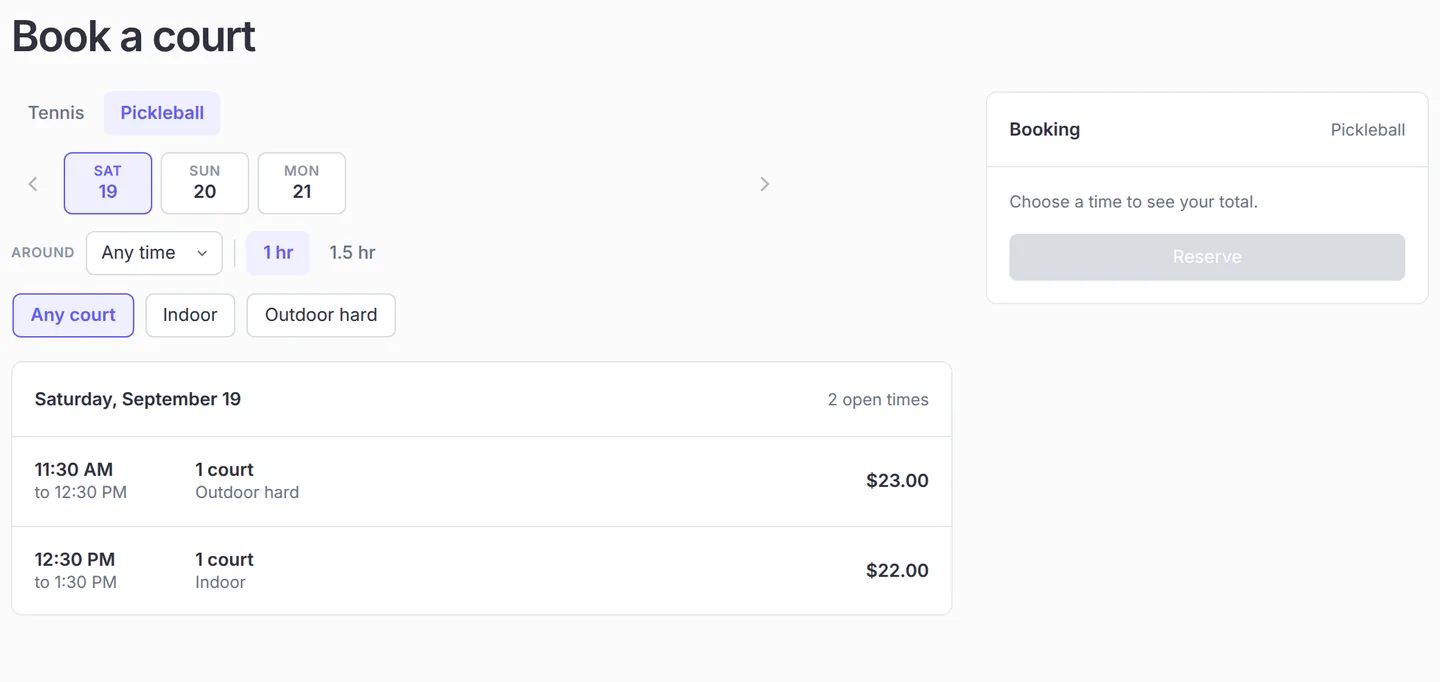
Set it up with Add and configure courts and Set booking rules and rates, or read how tennis and pickleball work together on the Product page. Pricing is $100 a month for the whole club. See Pricing and Is it a fit?.
Questions clubs ask about shared courts
Can you play pickleball on a tennis court?
Yes. Pickleball lines can be added to a tennis court. USTA guidance for blended lines suggests up to two pickleball courts on one tennis court, one on each side of the net. Read the USTA and USA Pickleball guidance and talk to your court builder before you paint.
How do you stop tennis and pickleball double booking a shared court?
Treat the shared court as one court in your booking system. A booking in either sport should hold the whole court. Then it no longer shows as open for the other sport. In Tennisbook, that's how a court set to both sports works.
Should pickleball and tennis cost the same?
That's up to your club. You can keep one price per court hour, or price each sport separately. In Tennisbook, a shared court has a separate rate for each sport.
When should a shared court be used for pickleball?
Start from demand. Look at when each group asks for courts, try a schedule for a month, then adjust. Fixed sport blocks are easy to explain, and letting members choose the sport when they book is more flexible.
Can members book a shared court online?
Yes. Members choose the sport when they book. Each sport on a shared court can be open or closed to online booking. Close one, and the front desk books that sport.
Can we keep some courts tennis only?
Yes. Set those courts to tennis only and they never show up for pickleball. You can mix single-sport and shared courts at the same club.
Set up your shared courts
Set up your club, add your courts, mark the shared ones, and book Court 1 yourself, the way your members will.